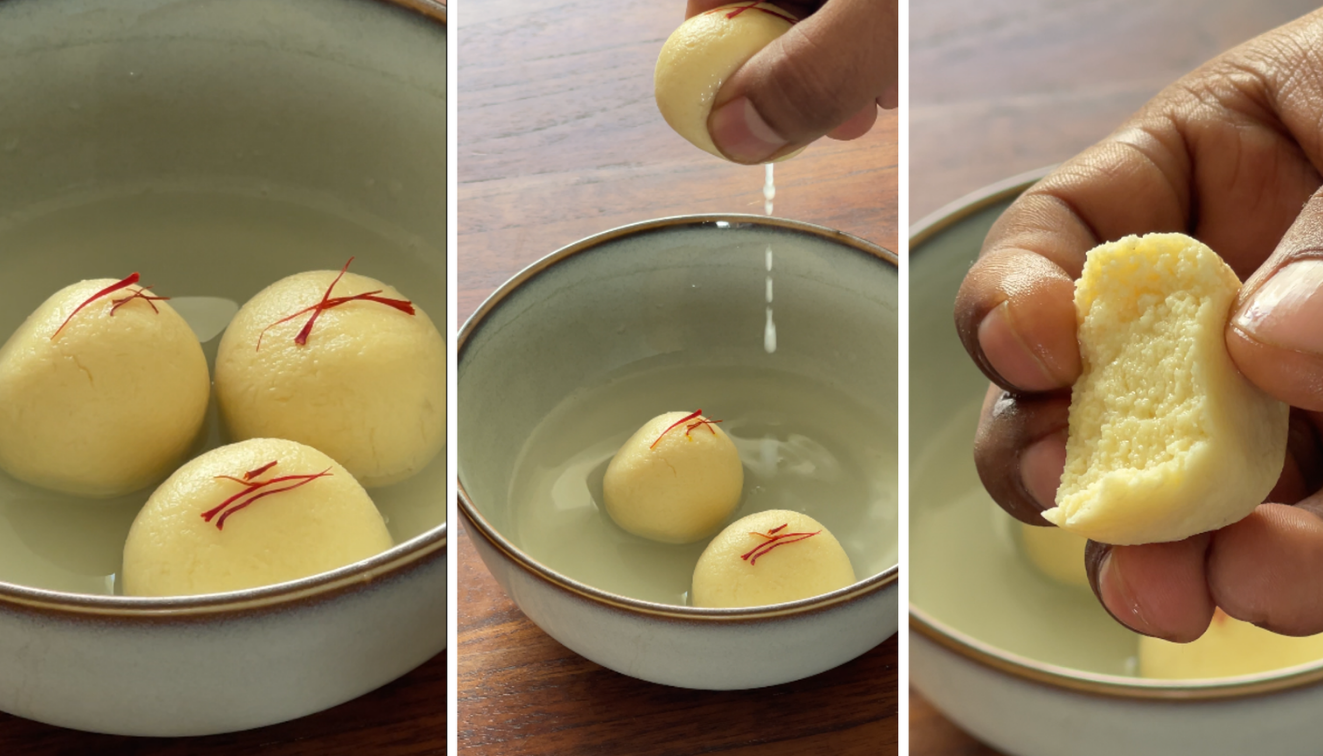
Rosogolla, also spelt Rasgulla, is a popular Indian dessert made from fresh paneer or chhena (Indian cottage cheese) balls cooked in sugar syrup. It’s a delightful sweet that originated in the Indian state of West Bengal but is enjoyed all over the country and beyond.
The origins of Rasgulla can be traced back to the eastern state of Odisha, where it has been a traditional offering in the Jagannath Temple in Puri for centuries, possibly since the 12th century. The sweet was traditionally called Khira Mohana, which later evolved into the Pahala Rasgulla.
Rasgulla became popular in neighboring West Bengal around the 19th century. The version of Rasgulla known today was popularized by Nobin Chandra Das, a confectioner in Kolkata in the 1860s. His innovation was to make these cheese balls more spongy and syrupy than the denser versions of Odisha.
Though, as per the Dandee Ramayana, rasgulla existed in Odisha from 1500 A.D., the science of soft and smooth channa processing was unveiled to Indians by the Portuguese colonists.
The dispute over the origin between Odisha and West Bengal led to seeking Geographical Indication (GI) status, which identifies a product as originating from a specific region. In 2017, GI status was awarded to “Banglar Rasogolla” (West Bengal’s version of the sweet), acknowledging the sweet’s development into its current form in the state. Later, in 2019, “Odisha Rasagola” also received GI status, recognizing its historical origins and cultural significance in Odisha.
What you will need:
For chhena balls
| Ingredient | Measure |
| Milk, full fat | 1 ltr |
| Vinegar | 2 part |
| Warm water | 3 part |
| Corn starch / Corn Flour | 2 tsp |
For the syrup
| Ingredient | Measure |
| Sugar | 1 cup |
| Water | 2 cup |
| Cardamom pods, crushed | 4-5 pods |
| Bay leaf (Optional) | 2 leaves |
| Saffron (Optional) | 1 pinch |
Preparation Time & Cook Time
Preparation time – 30 minutes
Cooking time – 15 minutes
Estimated Calories and Serving Portion
Calories per serving – 150kcal
Servings -12 rosogollas
Equipments:
- Heavy-bottomed pan
- Muslin cloth or fine strainer
- Large pot for boiling
- Slotted spoon
- Measuring cups
- Mortar and pistle
Instructions:
Jump to this article to learn to make fresh chhena needed for this recipe. Once you have the chhena (cottage cheese) follow the rest of the recipe as given below.
Making Chhena Balls
- Take the drained chhena on a clean surface or plate.
- Add the corn starch or corn flour and start kneading.
- Knead the chhena with the heels of your hands until it becomes smooth and soft (approximately 5–7 minutes).
- This kneading process is crucial for the right texture of the Rosogollas.

Shaping the Rosogollas
- Divide the kneaded chhena into small lemon-sized balls. Gently roll them between your palms to make smooth, crack-free balls.
- Cover the chhena balls with a damp cloth to prevent drying while shaping the rest.
Making the sugar syrup
- In a wide and deep pan, combine water and sugar, and bring it to a boil.
- Add cardamom pods and bay leaf to enhance the flavour of the syrup (optional).
- Let the syrup boil for a few minutes.
Syrup consistency
The unit widely used to measure consistency of sugar syrups is Taar or string.
1 taar or one string consistency indicates the syrup is thick enough that if a drop of the syrup is rubbed between thumbs, and gently pulled apart, it will form one string.

Rosogollas syrup is generally lighter than one string consistency and has a 1:2 ratio of sugar to water quantity.
Cooking the chhena balls in sugar syrup
- Carefully drop the chhena balls one by one into the boiling sugar syrup.
- Cover the pan and let the Rosogollas cook on medium heat for about 15 minutes.
- The chhena balls will puff up and become spongy.

- Turn off the heat and let the Rosogollas sit in the syrup for a few more minutes.
- The Rosogollas will absorb the sugar syrup and become even more delicious as they cool.
Garnish with Saffron and serve the Rosogollas warm or chilled, along with some sugar syrup. Enjoy the melt-in-your-mouth goodness of this delightful Indian sweet!

Rasgulla is more than just a sweet treat in India; it’s a part of cultural and religious festivities, especially during Diwali and Durga Puja. Its popularity has spread across India and even internationally, making it one of the most iconic Indian sweets.
The history of Rosogolla is a fascinating tale of culinary invention, cultural pride, and regional rivalry, highlighting the rich and diverse culinary heritage of India.
My Tips:
- Quality of Milk: Use full-fat cow milk for the best results. The fat content contributes to the softness and richness of the chenna (cottage cheese). You can use a 1:1 mixture of cow and buffalo milk as well.
- Timing: Timing is very important while processing the chhena. Do not let it drain too long, 30 mins is good enough.
- Formation of Chenna: When curdling the milk, use a food-grade acid like lemon juice or vinegar. Ensure the milk is fully boiled before adding the acid for a clean separation of whey and solids.
- Kneading Chenna: Knead the chenna until it’s smooth and pliable. Over-kneading can make it rubbery, while under-kneading can lead to cracks in the rosogollas.
- Sugar Syrup Consistency: The syrup should be thin. Thick syrup won’t penetrate the balls, leaving them dry inside. A light simmer keeps the syrup at the right consistency for the rosogollas to absorb sweetness.
- Cooking Process: Ensure the rosogollas have enough space to expand in the pan. They can double in size, so don’t overcrowd them. Cook them in a covered vessel to ensure even cooking and expansion.
Troubleshooting Guide:
Chhena does not come together
Trouble – This often happens if the temperature of the milk is low.
Shoot It – Make sure the milk is above 50 degrees celsius while making the chhena. The heat helps keep the chhena soft and together.
Cracked Rosogollas
Trouble – Could be due to under-kneaded chenna or adding the balls to the syrup before it reaches a rolling boil.
Shoot It – Ensure the syrup is boiling well when you add the balls.
Hard Rosogollas
Trouble – You have used more than recommended corn starch or corn flour.
Shoot It – Use only 1–2 tsp for 100–150 gms of chhena.
Rosogollas Not Expanding
Trouble – This could be due to the low-fat content in the milk or not enough space for the balls to expand.
Shoot It – Use full-fat milk and a large enough pan.
Remember, some of the key factors to get soft and juicy rosogollas are the fat content in the milk, moisture in the chhena, kneading time and sugar syrup consistency.
Making perfect Rosogollas may take some practice, but the end result is worth it. Enjoy these soft and spongy treats with your family and friends!
Don’t forget to share your results and tag @bake.hows on instagram
