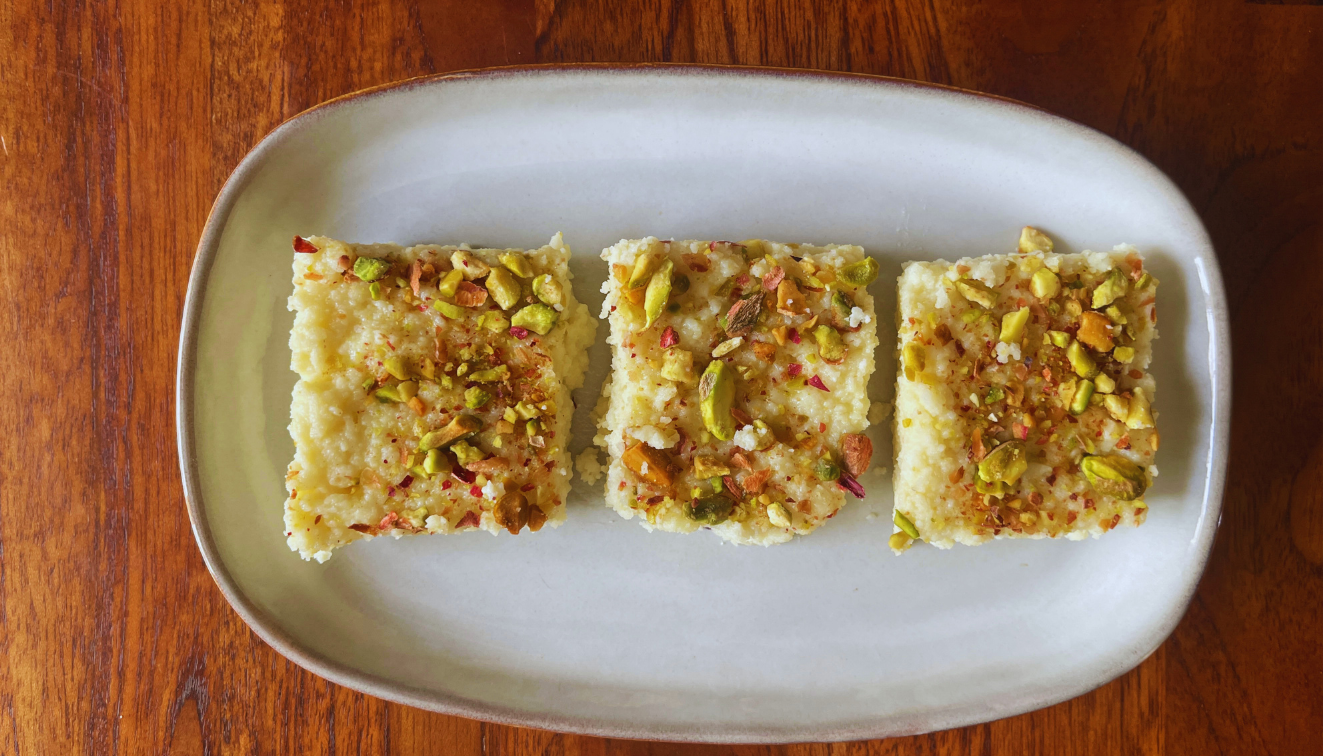
Kalakand, a classic Indian sweet, is renowned for its rich, milky flavour and grainy texture. This delicacy originates from the Indian subcontinent and is especially popular during festivals and celebrations. Made with just a few ingredients, primarily milk and sugar, Kalakand is a testament to the simplicity and elegance of traditional Indian sweets.
One popular theory suggests that Kalakand was first made in the late 1940s in the town of Alwar, Rajasthan, India. This version of the story credits a sweet maker (halwai) with the accidental invention of Kalakand. According to folklore, he left some milk on the stove, and it curdled.
Not wanting to waste the milk, he added sugar and set it aside. To his surprise, the mixture solidified into a moist, granular sweet that was well-received by those who tried it. Thus, the first iteration of Kalakand was born, earning Alwar the nickname “the City of Kalakand.”
Traditionally, Kalakand is made by simmering milk for a long duration to reduce it and then adding an acid (like lemon juice or vinegar) to curdle it slightly. Sugar and other flavorings such as cardamom or saffron are then added. The mixture is stirred continuously until it thickens and then set to cool, solidifying into a moist, cake-like structure.
What you will need:

For the fresh chhena
| Ingredient | Measure |
| Milk, full fat | 1 ltr |
| Vinegar | 2 part |
| Warm water | 3 part |
For the rest
| Ingredient | Measure |
| Milk, full fat | 0.5 ltr |
| Condensed Milk | 1/3 Cup |
| Sugar | 1/4 – 1/3 Cup |
| Dry fruits , roasted, chopped | 1/2 cup |
| Saffron (optional) | 1 pinch |
Preparation Time & Cook Time
Cooking time – 40 minutes
Setting time – 1 hour
Estimated Calories and Serving Portion
Calories per serving – 150kcal/piece
Servings – 20 pieces
Equipments:
- Heavy bottom pan
- Muslin cloth or fine strainer
- Flat tray or plate for setting
- Spatula
- Measuring cups and spoons
- Knife
Instructions:
Jump to this article to learn to make fresh chhena needed for this recipe. Once you have the chhena (cottage cheese) follow the rest of the recipe as given below.
Prepping the Chenna
- Lightly knead the chhena with the heels of your hands until it turns into coarse texture (approximately 5 minutes).

Reducing the Milk
- In a heavy-bottomed pan, bring the remaining half of the milk to a boil and add the condensed milk to it.
- Simmer over low to medium heat, stirring continuously, until the milk is reduced to half its original volume. This creates a thick, condensed milk base.

- Once the mixture thickens and starts to leave the sides of the pan, add sugar, cardamom, saffron and rose water (if using).
- Filter the reduced milk using a sieve.

If using saffron
You can dissolve the saffron in a tablespoon of warm milk and add it to the mixture for color and aroma or simply sprinkle over the kalakand as garnish.
Cooking the chhena
- Add the chenna to the reduced milk and mix well. Continue cooking the mixture on a low flame, stirring continuously to prevent it from sticking to the bottom of the pan.
- Cook until the mixture becomes a thick, solid mass and begins to form a dough-like consistency.

Setting the kalakand
- Grease a tray or a flat plate with a little ghee or butter.
- Transfer the kalakand mixture to the greased tray and spread it evenly with a spatula or the back of a spoon. Aim for a thickness of about 1/2 to 3/4 inch.

- Sprinkle chopped pistachios or almonds on top for garnish. Gently press the nuts into the mixture with the spatula.
- Allow the kalakand to cool down to room temperature. Once cooled, place it in the refrigerator for 30 minutes to 1 hour to set.

Serving suggestions
- Once set, cut the kalakand into squares or diamonds using a sharp knife.
- Serve chilled or at room temperature as a delightful end to a meal or as a snack during festive occasions.
Kalakand’s enduring popularity is a testament to its delightful taste and the richness it brings to India’s vast repertoire of sweets. Its simplicity, coupled with the joy of communal preparation during festive times, ensures it remains a cherished treat in Indian culture.
My Tips:
- Use full-fat milk for the best flavor and texture.
- Constant stirring is crucial when reducing the milk to prevent burning and ensure even thickening.
- The consistency of the mixture should be like thick fudge before setting; it should not be too liquidy or too dry.
- For a quicker version, you can use store-bought paneer (Indian cottage cheese) instead of making chenna, and condensed milk to reduce the cooking time.
Today, to expedite the traditional long process, many cooks use condensed milk and paneer or ricotta cheese to achieve a similar texture and taste within a shorter time frame. These innovations make it more accessible to prepare this sweet at home.
Troubleshooting Guide:
Kalakand too dry
Trouble – If the kalakand turns out too dry, it might have been cooked for too long.
Shoot It – Ensure to keep an eye on the consistency and remove from heat once it begins to leave the sides of the pan.
Not setting properly
Trouble – If the kalakand doesn’t set properly, it might not have been cooked down enough.
Shoot It – You can return the mixture to the pan and cook it a bit longer to achieve the desired consistency.
Don’t forget to share your results and tag @bake.hows on instagram
