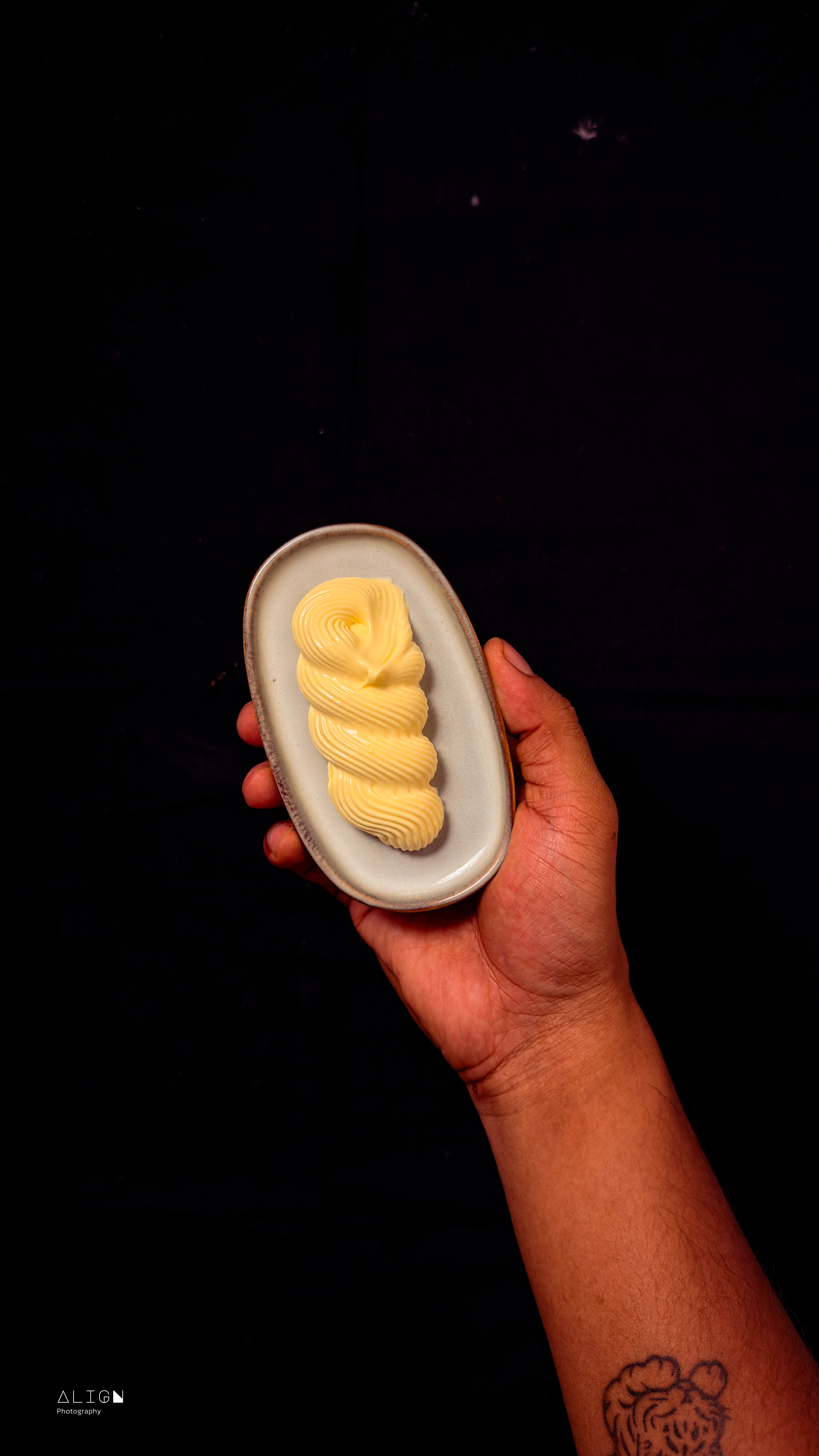
Silky Citrus Cream Topping
This orange namelaka recipe uses a Japanese pastry technique whose name literally means “ultra creamy,” describing both the texture and the method: a white chocolate ganache emulsified with a small amount of gelatin, then finished with cold cream so it sets just soft enough to spoon, pipe, or spread, never as firm as a mousse or as loose as a sauce.

The namelaka method was popularized in modern French pastry kitchens, most notably by Valrhona, as a way to get a smoother, more stable set than a standard ganache, using less gelatin than a Bavarian cream and no eggs at all. This orange version steeps zest into warm milk before building the emulsion, then finishes with fresh orange juice for a bright, tart edge against the white chocolate’s sweetness. It sits alongside citrus curd, orange cream, and Bavarian-style fillings as one of the more reliable ways to get a stable, pipeable citrus cream.
What you will need:
| Ingredient | Quantity |
| White chocolate | 169g |
| Whole milk | 45g (45mL) |
| Heavy cream, cold | 178g (178mL) |
| Orange zest | 7g |
| Orange juice, fresh | 89g (89mL) |
| Honey | 5g |
| Vanilla extract | 4g |
| Gelatin, powdered | 3g |

Equipments:
- Digital Scale
- Small bowl (for blooming gelatin)
- Small saucepan
- Fine mesh strainer
- Heatproof bowl or tall jug
- Immersion blender or whisk
- Plastic wrap
- Piping bag (optional, for application)
General Details:
Prep Time: 20 minutes
Cook Time: 5 minutes
Total Time: 20 minutes active, plus 6-12 hours chilling
Yield: About 500g, enough to top one 10-inch loaf cake
Difficulty: Intermediate
Cuisine: French, Japanese-influenced
Category: Pastry Cream
Storage: Keep covered with plastic wrap pressed to the surface in the refrigerator for up to 3 days. Not suitable for freezing once set.
Instructions:
Infuse and Build the Base
- Sprinkle the powdered gelatin over a small amount of cold water (about 4-5 times its weight) and let it sit for 5-10 minutes until fully absorbed and spongy.
- Warm the whole milk, heavy cream, honey, and orange zest together in a small saucepan until just below a simmer.
- Remove from the heat and let steep for 5-10 minutes to infuse the zest.
- Strain out the zest, then whisk the bloomed gelatin into the warm milk until fully dissolved.

Emulsify the Namelaka
- Pour the warm milk mixture and orange juice over the white chocolate in three additions, whisking or blending in the center after each addition to build a smooth, glossy core emulsion.
- Strain the mixture through a fine mesh sieve into a clean container to remove any undissolved bits or zest fragments. (Optional)
- Press plastic wrap directly onto the surface to prevent a skin from forming.
- Refrigerate for a minimum of 6 hours, ideally overnight, until fully set and crystallized.
- Whisk lightly just before use to loosen, or pipe directly if a firmer set is desired.


More Variations
- Spiced Orange Namelaka : Infuse a cinnamon stick or star anise alongside the orange zest for a warmer, more autumnal flavor.
- Dark Chocolate Namelaka : Replace the white chocolate with a 55-60% dark chocolate and reduce the honey slightly, since dark chocolate needs less sweetness balance.
Serving Suggestions
- Pipe in rosettes or swirls over a cooled carrot cake for a clean, bakery-style finish.
- Spread smooth with an offset spatula for a rustic, home-style topping.
- Pair with a few segments of fresh orange or candied peel for extra citrus presence.
Nutrition Profile / 100g
| Nutrient | Amount |
| Calories | 326 kcal |
| Total Fat | 24.0 g |
| Saturated Fat | 14.4 g |
| Carbohydrates | 24.6 g |
| Sugars | 24.1 g |
| Protein | 3.7 g |
| Fiber | 0.2 g |
| Sodium | 49 mg |
Note: These values are approximate and can vary based on the specific brands and types of ingredients used, as well as portion sizes.

Tips for Best Results:
Use a good-quality white chocolate with at least 30% cocoa butter. Lower-quality compound coatings will not set with the same silky texture.
- Emulsify in small additions rather than dumping all the liquid in at once. A tight, glossy core emulsion is what gives namelaka its signature smoothness.
- An immersion blender produces a noticeably smoother, more stable emulsion than whisking by hand, especially at the cream and juice stage.
- Do not skip the overnight chill. Namelaka needs time for the gelatin network and cocoa butter to fully crystallize, and it will taste and pipe differently at 2 hours versus 12.
- If the mixture looks split or grainy after blending, it is usually too cold; gently rewarm over a bain-marie while blending to bring it back together.
- Strain the milk-zest infusion well. Small bits of zest left in can clog a piping tip.

Troubleshooting Guide:
| Issue | Possible Cause | Fix |
| Namelaka never sets firm enough to pipe | Insufficient chilling time, or gelatin was not fully bloomed and dissolved | Chill for a full 12 hours and confirm the gelatin was completely dissolved into the warm milk before straining |
| Mixture looks grainy or split | Chocolate seized from too-cold liquid added too quickly, or overheating during emulsification | Add the warm milk in small stages, blending at the center each time, and rewarm gently over a bain-marie if it splits |
| Namelaka tastes too sweet | White chocolate and honey combined push sweetness high with no counterbalance | Increase the orange juice slightly or add a touch more zest to sharpen the citrus edge |
| Zest flavor is weak | Zest steeped too briefly or in liquid that was not hot enough | Bring the milk closer to a simmer before steeping and extend the steep time to a full 10 minutes |
| Bits of zest end up in the final texture | Milk infusion was not strained thoroughly | Pass through a fine mesh sieve, pressing gently to extract all liquid before discarding the zest |
| Namelaka weeps liquid after piping | Piped before fully set, or gelatin ratio was too low for the application | Ensure a full chill before piping, and pipe cold, working quickly |

You Might Also Like
Don’t forget to share your results and tag @bake.hows on instagram
