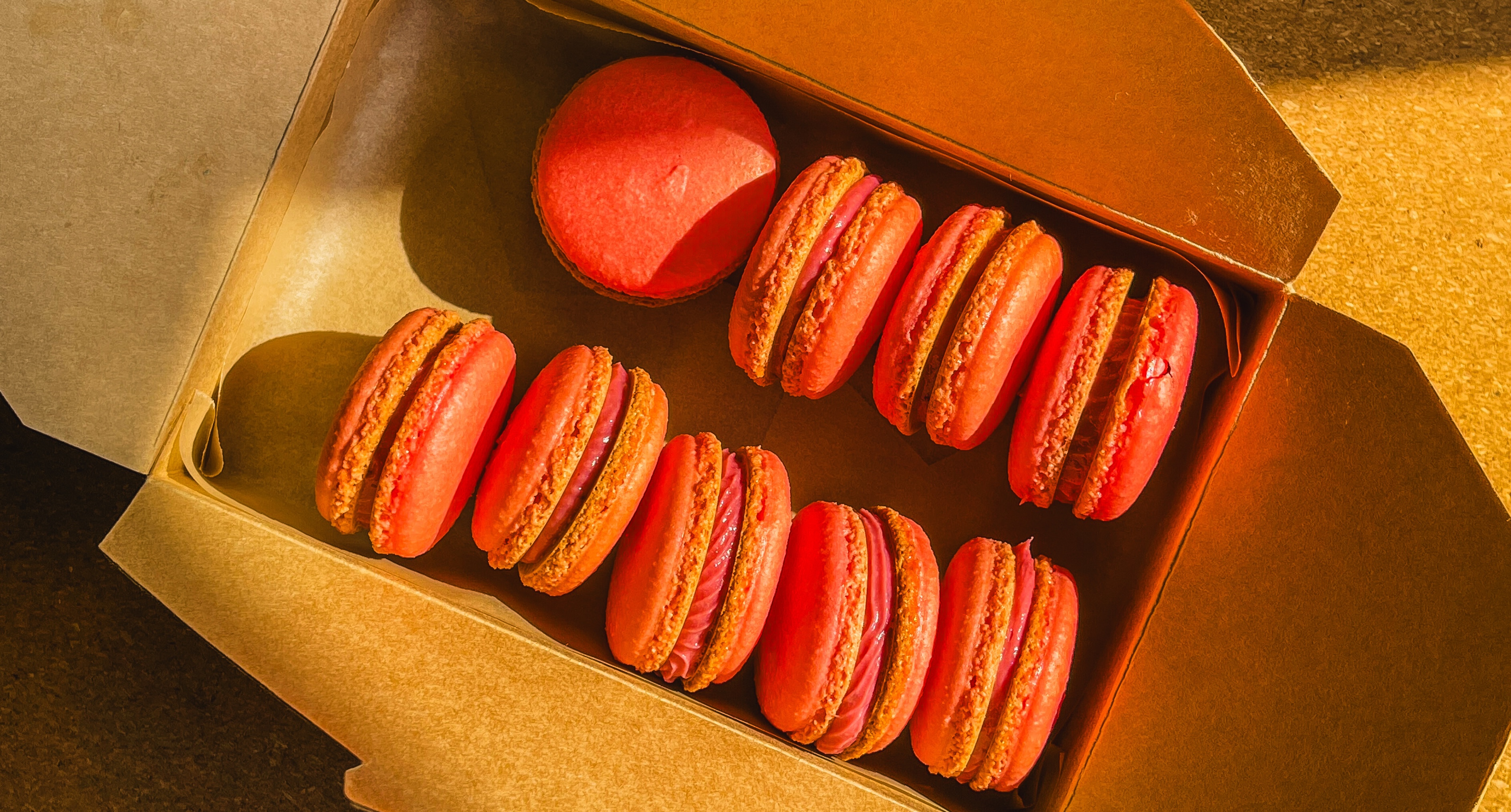
Macarons are delicate French confections known for their smooth, crisp shells and chewy interior, often filled with various rich fillings like buttercream, ganache, or jam.
They date back to the 8th century, but the Parisian macaron as we know it today, with its iconic “feet” and sandwich structure, was popularized in the 20th century.
Making macarons requires precision, but using the French meringue method simplifies the process slightly by whipping the egg whites with sugar to create a stable meringue base. Let’s dive into making these delightful cookies!
What you will need:

| Ingredient | Measure |
| Almonds Flour (Fine to Superfine) | 60g |
| Confectioner’s Sugar | 60g |
| Superfine Sugar | 45g |
| Egg White (Room Temperature) | 50g |
| Cream of tartar (optional, for stability) | 1/8 tsp |
| Food Colouring | 1 drop |
Time Required
Prep Time: 20 minutes
Resting Time: 30-60 minutes
Bake Time: 15-18 minutes
Nutrition Profile / 100g
Calories: 368 kcal
Protein: 8.4g
Carbohydrates: 54.8g
Fat: 13.9g
Equipments:
- Digital scale
- Food processor
- Stand mixer / hand mixer
- Flour sifter
- Silicon spatula
- Pipping bag and round tip nozzle
- Silicon mat
- Oven thermometer
Instructions:
Prepare Dry Ingredients:
- Pulse the almond flour and confectioner’s sugar in a food processor 5-7 times to combine them well.
- Sift the mixture into a large mixing bowl to remove any lumps.
- Discard any large almond pieces left behind.

Make the Meringue:
- I would recommend starting with French meringue first as it is the classic way of making macarons. Even though Italian meringue is quite popular for better results, in my experience it can be too complicated for a beginner.
- Try different types of meringue for macarons to find the one that works well with you.

Combine Wet and Dry Ingredients:
- Add the sifted almond flour and powdered sugar mixture to the meringue in thirds, gently folding after each addition using a spatula.
- Fold until the batter flows slowly and resembles molten lava. Test by drawing a figure 8 with the batter; it should flow smoothly without breaking.

Technique Highlight : Macaronage
Macaronage is the technique used to mix the meringue with the dry ingredients (almond flour and powdered sugar) when making macarons. The goal of macaronage is to achieve a smooth, flowing batter that isn’t too stiff or too runny.
After adding the dry ingredients to the meringue, gently fold the mixture using a spatula. Start by scooping from the bottom and around the sides, then pressing down the batter to deflate some air, all while rotating the bowl.
Pipe the Macarons:
- Transfer the batter to a piping bag fitted with a round tip.
- Pipe small circles (about 1.5 inches in diameter) onto a baking sheet lined with a silicone mat. Leave space between each macaron.
- Tap the baking sheet firmly on the counter a few times to release any air bubbles.
- Let the macarons sit at room temperature for 30-40 minutes, or until a thin skin forms on the surface.

Bake the Macarons:
- Preheat the oven to 150°C (300°F).
- Bake the macarons for 15-18 minutes (without fan).
- They should form “feet” (the ruffled bottom edge) and have a smooth top.
- Allow them to cool completely on the tray before removing them.

Assemble the Macarons:
- For a buttercream filling, beat the butter until light and fluffy. Add powdered sugar and vanilla extract, then mix until well combined. If the buttercream is too thick, add a tablespoon of cream to achieve the desired consistency.
- You can also try this strawberry ganache.
- Match similar-sized shells. Pipe a small amount of filling onto the flat side of one shell and sandwich with another.

Macarons are best enjoyed with tea or coffee. You can store them in an airtight container in the fridge for 24-48 hours before serving to allow the flavors to meld. Let them sit at room temperature for 10 minutes before eating.
My Tips:
- Room Temperature Eggs: Make sure your egg whites are at room temperature, as this helps achieve a more stable meringue.
- Be sure not to have any egg yolk in the separated egg whites, not even in trace amount.
- Macaronage (Folding Technique): Be careful not to overmix or undermix. Aim for the “molten lava” consistency where the batter flows slowly and smoothly.
- Resting Time: Don’t skip resting the macarons. This step is crucial to forming the signature “feet.”
- Copper bowls are best for whipping meringue.
- Silicon mats appear to give better results.

Troubleshooting Guide:
My almond meal feels too damp
Dry it out by spreading the almond meal thinly on a baking sheet and placing it in a warm (but not hot) oven for a few hours.
My almond meal contains seed coat pieces
If finely ground, seed coats are acceptable and result in speckled macarons. The example of peanut macarons demonstrates this.
My meringue texture is grain
The meringue has been over-beaten. Try using a medium-low speed and monitor frequently to avoid over-mixing. There’s no need to rush.
My meringue won’t firm up, staying soft and foamy
Possible reasons include:
– Insufficient beating time.
– Beating in a plastic or not thoroughly clean bowl.
– Trace amounts of egg yolk present in the whites.
Use a scrupulously clean stainless steel or copper bowl. Add a bit of acid, like lemon juice, cream of tartar, or salt, to help stabilize the meringue.
My macaron batter is too thick
This might be caused by under-mixing or incorrect ingredient measurements.
My macaron batter is too runny
This could result from over-mixing, an improperly beaten meringue, or inaccurate measurements.
My macaron tops are blotchy
This can happen if the meringue is not adequately beaten or the batter is over-mixed.
My macarons have domed, lumpy tops without feet
This could be due to under-mixing (causing fine lumps) or a broken meringue (leading to a sandy texture).
My macarons are wrinkly like rumpled wax paper
This could be the result of over-mixing, under-beating the meringue, cooking at too low a temperature, insufficient resting, or undercooking.
My macarons have bubbles
Not tapping the tray on the counter or failing to pop air bubbles before baking could be the issue.
Don’t forget to share your results and tag @bake.hows on instagram
