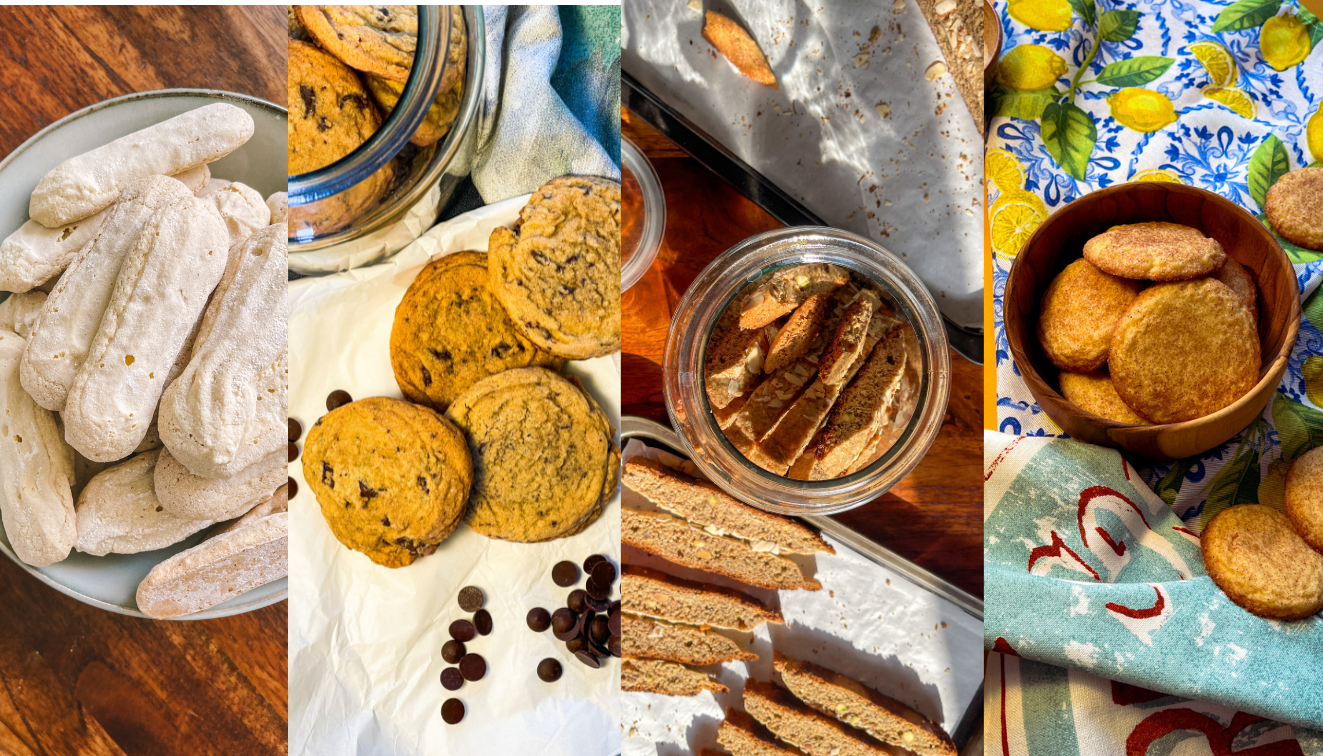
Cookies are classified not only by their ingredients but also by the techniques used to shape and bake them. These methods influence the texture, appearance, and overall baking outcome. Below is a detailed exploration of cookie-making techniques based on the provided references:
Bagged (Pressed) Cookies
Bagged cookies are created from soft doughs that can hold their shape but are pliable enough to be piped through a pastry bag fitted with a specific tip.
Technique:
- Fit a pastry bag with a desired tip shape (e.g., star, round).
- Fill the bag with soft cookie dough.
- Pipe the dough directly onto a baking sheet, ensuring uniform size and spacing.
Examples:
- Spritz Cookies: Traditionally flavored with almond or vanilla, these are festive and often decorated with colored sugar or sprinkles.
- Butter Rosettes: Delicate cookies shaped into flower-like patterns.
Key Tip
If the dough is too stiff, it can be warmed slightly or double-bagged to prevent tearing.

Dropped Cookies
Dropped cookies use a scoop or spoon to portion out soft dough, resulting in a more rustic, homemade appearance.
Technique:
- Select a portion scoop to ensure uniform size.
- E.g., No. 16 scoop for large cookies (60–70 g), No. 30 for medium (30 g).
- Drop dough onto prepared baking sheets, leaving space for spreading.
- For certain recipes, flatten mounds slightly with a weight or fork.
Examples:
- Chocolate Chip Cookies: A quintessential example, with dough that spreads naturally in the oven.
- Oatmeal Raisin Cookies: Dense and chewy, these are ideal for the dropped technique.
Key Tip
To achieve consistent baking, ensure cookies are of the same size to avoid uneven cooking.


Rolled Cookies
Rolled cookies are made from firm dough that is chilled, rolled out thin, and cut into shapes using cookie cutters.
Technique:
- Thoroughly chill dough to ensure easier handling.
- Roll out dough to 3 mm (⅛ inch) thickness on a lightly floured surface.
- Cut out shapes as closely as possible to minimize scraps.
- Decorate before baking (e.g., with colored sugar) or after baking (e.g., royal icing).
Examples:
- Sugar Cookies: Often used for holiday-themed cutouts, decorated elaborately with icing.
- Gingerbread Cookies: Spiced cookies popular for festive shapes like gingerbread men.
Key Tip
Re-roll scraps minimally to prevent toughness from overworking the dough.

Molded Cookies
Molded cookies are shaped by hand or pressed into molds to create intricate designs or uniform shapes.
Technique:
- Roll dough into uniform cylinders and refrigerate if necessary.
- Cut cylinders into pieces of the desired size using a bench scraper.
- Shape cookies by hand or flatten with a weight (e.g., a can or mold) to add designs.
Examples:
- Peanut Butter Cookies: Typically flattened with a fork to create a crosshatch pattern.
- Speculaas: Traditional Dutch spiced cookies often pressed into carved molds.
Key Tip
For even baking, ensure uniform thickness and spacing between cookies on the tray.

Icebox Cookies
The Icebox method, also called refrigerator cookies, is ideal for preparing cookie dough in advance and baking only as needed. This technique is highly efficient in professional settings where consistent shapes and sizes are crucial.
Technique:
- Divide dough into uniform portions (e.g., 700 g for small batches or up to 1.4 kg for larger batches).
- Roll dough into cylinders 2.5–5 cm (1–2 inches) in diameter, ensuring uniform thickness for even baking.
- Wrap the cylinders in parchment or wax paper. Place them on a baking sheet and refrigerate overnight to firm the dough.
- Once firm, slice dough into rounds of consistent thickness (3–6 mm) using a sharp knife.
- Use a slicing machine for precise cuts, especially for large batches.
- Place slices on a prepared baking sheet, leaving 5 cm (2 inches) of space between cookies.
Examples:
- Pinwheel Cookies: Two-tone doughs rolled together to create a spiral pattern.
- Shortbread Cookies: Often flavored with vanilla or citrus zest.
Key Tip
For doughs with nuts or fruits, slice with a knife instead of a machine to avoid breaking the inclusions.


Bar Cookies
The Bar method is used to bake dough in long strips, which are cut into smaller bars or cookies after baking. It is distinct from sheet cookies and particularly suited for producing biscotti or similar shapes.
Technique:
- Divide the dough into portions for consistency.
- Roll or press the dough into cylinders the length of the baking sheet.
- Flatten each strip into 8–10 cm (3–4 inches) wide bars.
- Brush the bars with egg wash to enhance color and gloss.
- Bake as directed. While the dough is still warm, cut each strip into individual bars 4.5 cm wide.
Examples:
- Biscotti: Twice-baked Italian cookies, ideal for dunking in coffee or tea.
- Almond Bars: Soft dough shaped into strips and cut into smaller servings.
Key Tip
Use a ruler to ensure equal-sized slices for uniform baking and presentation.


Sheet Cookies
Sheet cookies are baked as a single, even layer in a pan and are often cut into squares or rectangles after baking. This versatile method can produce cookies with layered designs or simple one-layer treats.
Technique:
- Spread the dough or batter into a prepared baking pan, ensuring an even thickness across the entire pan.
- Brush with egg wash or sprinkle with toppings (e.g., nuts, dried fruits, or sugar) before baking.
- Bake as directed. Allow to cool completely to maintain structural integrity.
- Turn the baked sheet onto a cutting board, then cut into squares, rectangles, or other shapes.
- This prevents damage to the sheet pan.
Examples:
- Biscotti: Twice-baked Italian cookies, ideal for dunking in coffee or tea.
- Almond Bars: Soft dough shaped into strips and cut into smaller servings.
Key Tip
For multilayer sheet cookies, bake each layer separately to prevent uneven baking or collapsing.
Stencil Cookies
The Stencil method involves spreading a soft batter, known as stencil paste, onto a silicone mat using a pre-cut stencil to create thin, intricate cookie designs. This technique is ideal for decorative cookies like tuiles.
Technique:
- Use a silicone mat or parchment paper as your base.
- Place a stencil (pre-made or handmade) on the mat.
- For custom shapes, use thick plastic or cardboard to create cutouts.
- Using an offset spatula, spread a thin, even layer of batter over the stencil.
- Ensure all cutouts are filled evenly.
- Carefully remove the stencil and repeat the process for the next batch of cookies.
- Bake until cookies are crisp and lightly golden.
Examples:
- Tuiles: Thin, crisp cookies often molded into curves while warm.
- Almond Lace Cookies: Delicate cookies with a lacy appearance.
Key Tip
Work quickly after baking to shape cookies before they harden, especially for designs requiring curves or bends.
Summary
| Technique | Key Features | Examples |
| Bagged | Soft dough piped through a pastry bag; requires uniform dough consistency. | Spritz Cookies, Butter Rosettes |
| Dropped | Soft dough dropped using a scoop or spoon; rustic, homemade appearance. | Chocolate Chip Cookies, Oatmeal Raisin |
| Rolled | Firm dough rolled thin and cut into shapes with cutters; often decorated. | Sugar Cookies, Gingerbread Cookies |
| Molded | Dough shaped by hand or pressed into molds; may include embossed designs or be flattened with weights. | Peanut Butter Cookies, Speculaas |
| Ice Box | Dough formed into logs, chilled, sliced, and baked; suitable for advance preparation. | Pinwheel Cookies, Checkerboard Cookies |
| Bar | Dough baked as long strips and cut into bars; may involve a second bake for crispness. | Biscotti, Almond Bars |
| Sheet | Cookie mixture spread in a single layer; baked and cut into shapes after cooling. | Brownies, Lemon Bars |
| Stencil | Batter spread thinly over a stencil to create intricate shapes; often used for decorative cookies. | Tuiles, Almond Lace Cookies |
