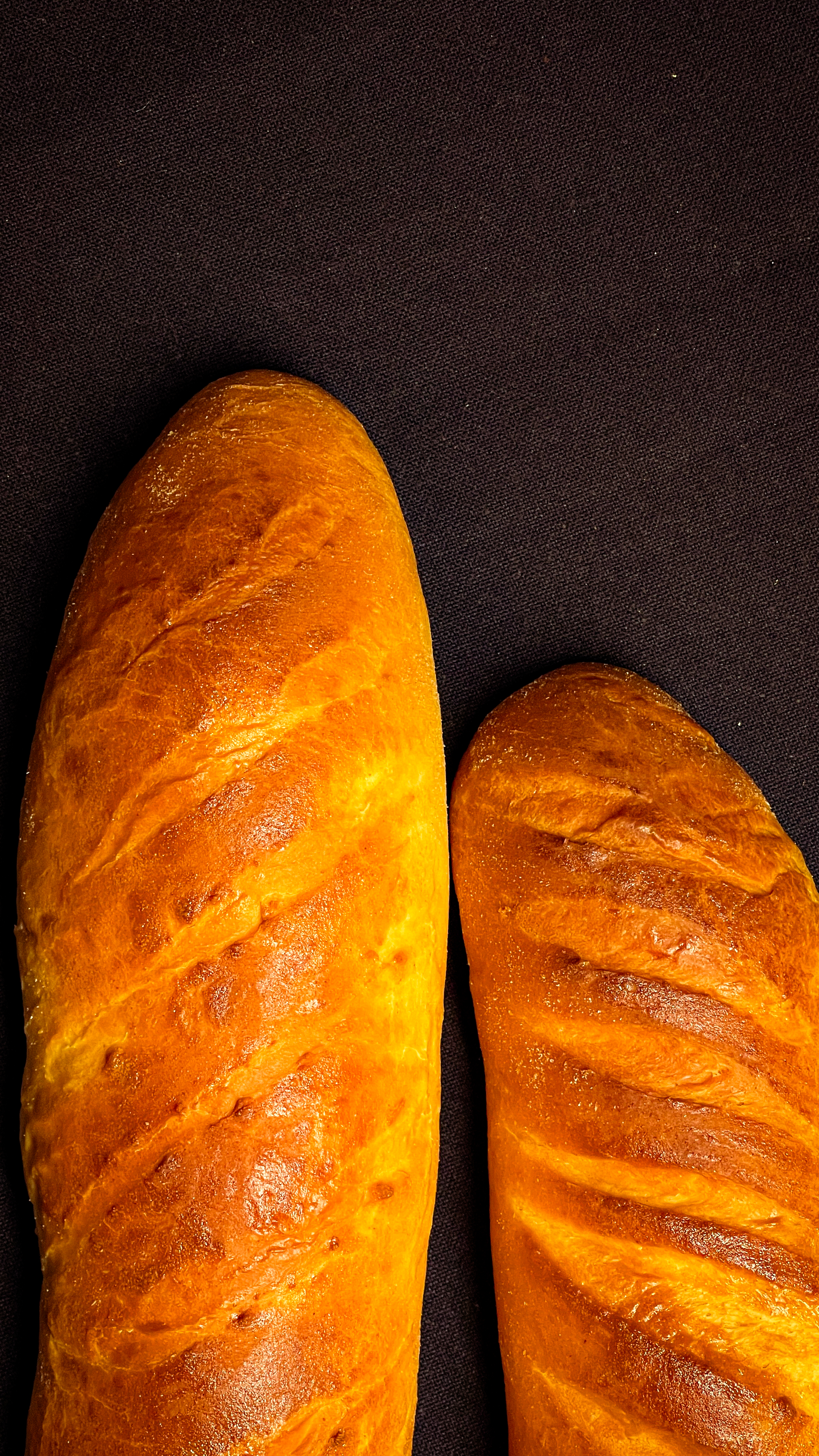
Viennoise Style
The Baguette Viennoise is a soft, enriched cousin of the traditional French baguette — tender yet structured, delicately sweet, and wonderfully aromatic. Originating in Vienna’s 19th-century baking culture, it was later embraced by French bakers who adapted the formula with local flour and fermentation techniques. Unlike the crisp, lean baguette de tradition, this version includes milk, butter, sugar, and eggs, yielding a golden crust and pillowy crumb — perfect for breakfast, tea service, or elegant sandwiches.
Viennese baking introduced Europe to steam baking and refined yeast doughs, revolutionizing French boulangerie in the 1800s. The Baguette Viennoise represents this cross-cultural exchange — a bridge between Austrian richness and French precision. It became a staple in Parisian cafés, often served with butter and jam or filled with ham and Gruyère for a refined déjeuner rapide.
What you will need:

| Ingredient | Measure |
| Bread Flour (T55) | 500g |
| Eggs | 55g |
| Milk | 300g |
| Sugar | 40g |
| Salt | 10g |
| Yeast | 3g |
| Butter | 70g |
Equipments:
- Digital Scale
- Flour sifter
- Stand mixer with dough hook
- Bench scraper and rolling pin
- Baguette pan or perforated baking tray or Clean Towel
- Pastry brush
- Lame or sharp blade for scoring
- Thermometer (for dough temperature control)
- Cooling rack

Time:
| Process | Duration | Temperature |
|---|---|---|
| Mixing & Initial Rest | 45 min | 24–26°C |
| Cold Fermentation | 12–15 h | 3–4°C |
| Shaping & Proofing | 2 h | 27–29°C |
| Baking & Cooling | 25 min | — |
Total Time: ~18 hours (including overnight fermentation)
Instructions:
Day 1 – Mixing and Cold Fermentation
- Combine milk, egg, yeast, sugar, flour, and salt to a mixing bowl. Mix 5 minutes on low speed until ingredients combine.
- Increase to medium speed for 2 minutes. The dough should begin to form elasticity.
- Add soft butter in portions and mix for 3 more minutes until smooth and elastic.
- Rest dough 30 minutes at 24–26°C. Divide into 250 g portions. Round each into a tight ball.
- Place dough balls on an airtight boxand refrigerate for 12–15 hours at 3–4°C.


Day 2 – Shaping, Proofing, and Baking
- Bring dough to room temperature (~30 min). Roll each piece into a long oval.
- Folding Technique:
- Fold top edge two-thirds down.
- Rotate 180° and repeat.
- Seal with the heel of your hand.
- Fold lengthwise again, sealing seam with thumb pressure.
- Roll gently from center outward to 50–54 cm with tapered ends.
- Place on baguette tray (seam down) or fold a towel to make ridges and place them there.
- Proof at 27–29°C, 80–84% humidity, for 1 h 45 min until dough springs back slowly when pressed.
- Brush with egg wash. Score diagonally with overlapping slashes.
- Bake at 210°C (410°F) for 14–16 minutes until deep golden.
- Cool on rack for at least 30 minutes before slicing.


Variations
Chocolate Viennoise: Add chocolate chips and reduce sugar by 10%.
Whole Wheat Version: Replace 20% flour with whole wheat; increase milk by 15 g.
Honey Butter Glaze: Brush with honey-butter mix post-bake for a glossy finish.
Mini Viennoise Rolls: Shape into 80 g rolls for individual breakfast portions.
Serving Suggestions
Slice and serve with cultured butter and apricot jam for a Viennese breakfast.
Use as a base for ham and Emmental sandwiches.
Transform into French toast with vanilla custard soak.
Pair with coffee, milk tea, or hot chocolate for a complete continental morning.

Nutrition Profile / 100g
Calories 392 kcal
Protein 3.4 g
Total Fat 0.1 g
Sodium 5 mg
Saturated Fat 0.03 g
Note: These values are approximate and can vary based on the specific brands and types of ingredients used, as well as portion sizes.

Tips for Best Results:
- Use high-protein bread flour (~12%) for optimal gluten elasticity.
- Ensure butter is pliable but not melted (18–20°C).
- Maintain dough below 27°C to prevent over-fermentation.
- Longer cold proofing (up to 18 h) enhances flavor complexity.
- Apply lightly before baking to avoid excessive browning.
- Oil your hands to handle the dough better.

Troubleshooting Guide:
| Issue | Likely Cause | Professional Solution |
|---|---|---|
| Dense crumb | Insufficient mixing or fermentation | Increase initial mixing or extend cold proof by 2–3 h |
| Crust too pale | Low oven temperature or light egg wash | Bake at 215°C; apply second light wash midway |
| Dough tearing during shaping | Over-proofed or under-hydrated dough | Reduce proof time or slightly increase milk by 10 g |
| Uneven browning | Inconsistent oven airflow | Use convection mode or rotate tray halfway |
| Flat baguettes | Weak shaping tension | Strengthen final fold and seam seal |

Don’t forget to share your results and tag @bake.hows on instagram
