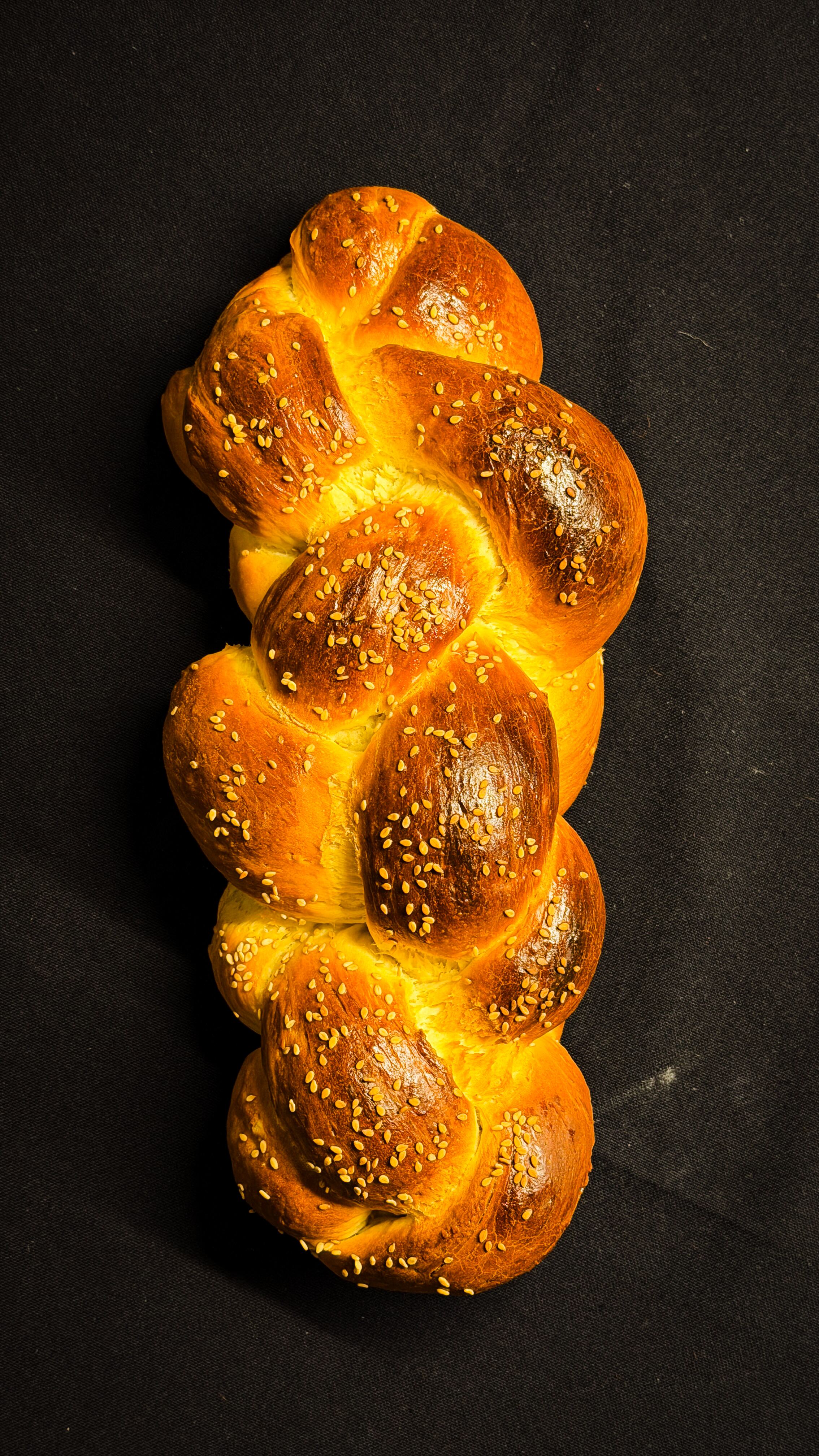
Jewish braided bread
Challah is a traditional Jewish braided bread served on Shabbat and holidays, revered not only for its rich, tender crumb but also for its spiritual meaning. Rooted in the Torah’s commandment to separate a portion of dough (hafrashat challah), it symbolizes gratitude and sanctity.

The iconic braids emerged in medieval Ashkenazi communities, where Jewish bakers enriched their loaves with eggs and oil, setting challah apart from everyday breads. Each braid holds symbolism: a four-strand braid often represents the matriarchs—Sarah, Rebecca, Rachel, and Leah—or the pillars of a faithful home—Torah, prayer, charity, and kindness.
Whether round for Rosh Hashanah or elongated for Shabbat, challah is more than food—it’s a legacy of memory, unity, and spiritual nourishment, shared across generations.
What you will need:

This version of challah marries the enriched softness of Jewish tradition with the complexity of Italian fermentation. By incorporating a biga preferment, this loaf gains a refined aroma, improved crumb, and longer shelf life. It’s a subtly transformative technique that enhances flavor without changing challah’s signature character.
| Ingredient | Biga | Dough |
| Bread Flour | 210g | 310g |
| Water | 125g | 100g |
| Sugar (Caster) | – | 50g |
| Salt | – | 12g |
| Yeast | 8g | – |
| Olive Oil | – | 60g |
Equipments:
- Digital Scale
- Flour sifter
- Stand mixer with dough hook
- Large bowl with cover
- Dough scraper or bench knife
- Baking tray lined with parchment
- Pastry brush (for egg wash, optional)
- Cooling rack
Time:
Biga Fermentation: 12–16 hours (overnight)
Mixing & Kneading: 25 minutes
First Fermentation: 1 hours
Shaping & Proofing: 1 hour
Baking Time: 25–30 minutes
Cooling Time: 1 hour
Instructions:
Prepare the Biga (Preferment)
- Mix the flour, water, and yeast in a bowl just until combined.
- Cover and ferment at room temperature for 12 to 16 hours, until the surface is domed and bubbly.


Mix the Final Dough
- In a stand mixer, combine the final dough ingredients along with the fully fermented biga.
- Mix on low speed until hydrated, then increase to medium and knead until the dough is smooth, elastic, and slightly tacky.

Bulk Fermentation
- Transfer dough to a lightly oiled bowl.
- Cover and let ferment for 60 minutes, performing one fold at the halfway mark to improve structure.

Divide and Shape
- Turn the dough out onto a lightly oiled work surface.
- Divide into equal portions depending on braid style.
- Pre-shape into balls and let rest briefly, then roll into strands and braid as desired.

4-Strand Braid Technique
Number the strands from left to right: 1, 2, 3, 4.
- Move strand 1 (far left) to the far right (becomes new 4).
- Strand 3 (now second from the right) crosses over to the far left (becomes new 1).
- Strand 2 (now second from left) goes to the far right (becomes new 4).
- Repeat the process:
Rightmost strand to far left, second-from-left to far right. - Continue this pattern, always:
Then the second-from-left strand to the far right.
Moving the far right strand to the far left - Once you reach the end, pinch the tips together and tuck both ends under the loaf.
- Gently adjust the loaf for symmetry.
- Let it proof as instructed before baking.


Final Proofing
- Place the braided loaf onto a parchment-lined tray.
- Cover loosely and proof at room temperature for about 30 minutes to 1 hour, or until puffed and slightly jiggly to the touch.

Baking
- Preheat the oven to 180°C (360°F).
- Optionally apply egg wash. Sprinkle some sesame seeds.
- Bake until the loaf is deep golden brown and sounds hollow when tapped on the base.
- Cool completely on a wire rack before slicing.

Variations
Add dried fruits like raisins or cranberries soaked in orange juice.
Swirl cinnamon sugar into each braid for a sweet version.
Mix in herbs or garlic confit for a savory twist.
Substitute 30% of the flour with whole wheat and increase hydration slightly.
Serving Suggestions
Pair with tahini and honey or fresh fruit preserves.
Excellent base for French toast or savory sandwiches.
Serve alongside shakshuka, dips, or soft cheeses for a rich breakfast spread.

Nutrition Profile / 100g
| Nutrition | Amount |
|---|---|
| Energy | ~295 kcal |
| Carbs | ~50.5 g |
| Sugars | ~4.1 g |
| Protein | ~7.9 g |
| Fat | ~6.5 g |
| Saturated Fat | ~0.8 g |
| Fiber | ~1.9 g |
| Sodium | ~435 mg |
Note: These values are approximate and can vary based on the specific brands and types of ingredients used, as well as portion sizes.
Tips for Best Results:
- Start your biga the night before for ideal workflow.
- Use oil instead of flour on your bench to maintain dough hydration.
- Always check your biga: it should smell slightly sweet and yeasty before using.
- Don’t skip the mid-proof fold—it boosts dough strength without kneading.
- Brush with egg yolk only for a richer color, or whole egg for a balanced sheen.
- Chill the shaped loaf briefly for cleaner scoring, if desired.

Troubleshooting Guide:
| Issue | Cause | Solution |
|---|---|---|
| Dough is too slack | Overhydration or under-kneading | Knead longer or reduce water slightly |
| Flat braids | Overproofed final dough | Shorten final proof and bake promptly |
| Dry crumb | Overbaking or low hydration | Monitor baking time; ensure correct ratios |
| No oven spring | Weak gluten or under-kneading | Ensure full gluten development |
| Pale crust | No egg wash or underbaking | Apply wash and bake until richly golden |
Don’t forget to share your results and tag @bake.hows on instagram
