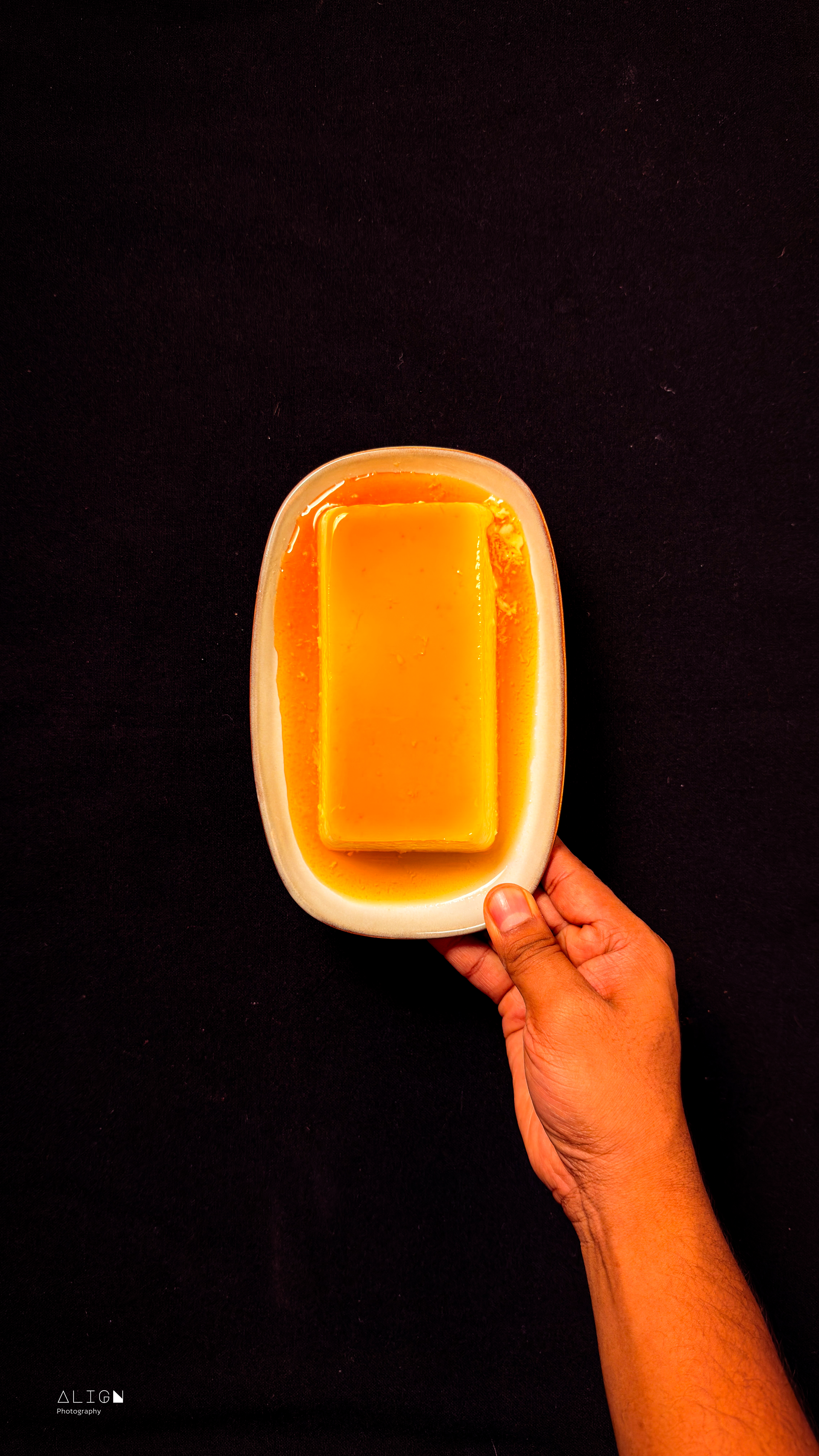
Silky Caramel Custard
This classic flan recipe produces a silky baked egg custard crowned with a deep, glossy caramel sauce, made with nothing more than eggs, milk, cream, and sugar. Every step, from caramelizing the sugar to tempering the eggs, is built to reward patience with a texture that is smooth, dense, and never rubbery.

Flan traces its roots to Roman custards sweetened with honey, later refined in Spain and carried to Latin America, where it became a staple of home baking and celebration menus. You may also see it referred to as creme caramel or flan de huevo depending on the region, but the technique across all of them stays the same: a caramel-lined mold, a strained custard, and a gentle water bath.
What you will need:
Caramel
| Ingredient | Quantity |
| Sugar | 100g |
| Water | 30g |
| Hot water (added off heat) | 20g |

Custard
| Ingredient | Quantity |
| Whole eggs | 98g |
| Egg yolks | 21g |
| Whole milk | 264g (264mL) |
| Heavy cream | 32g (32mL) |
| Sugar | 85g |
| Salt | 0.5g |
| Vanilla | 1g |
Equipments:
- Digital Scale
- 8-inch round flan mold or cake pan or Ramekins
- Heavy-bottomed saucepan (for caramel)
- Medium saucepan (for heating milk and cream)
- Fine-mesh sieve
- Whisk
- Large mixing bowl
- Deep roasting pan (for the water bath)
- Instant-read or probe thermometer (optional)
- Plastic wrap
General Details:
Prep Time: 25 minutes
Cook Time: 50 to 55 minutes
Total Time: 8 hours 20 minutes (includes a minimum 6-hour chill)
Yield: 1 flan, about 650g (6 to 8 servings) or Smaller Flans
Difficulty: Intermediate
Cuisine: Spanish / Latin American
Category: Dessert
Storage: Cover tightly and refrigerate up to 4 days; best within the first 2 days for the cleanest caramel release.
Instructions:
Make the Caramel
- Combine sugar and water in a heavy-bottomed saucepan.
- Cook over medium heat without stirring until the sugar melts and turns a deep amber color.
- Remove from heat and carefully add the hot water, swirling the pan to combine (the mixture will bubble vigorously).
- Pour the caramel immediately into the flan mold, tilting to coat the base evenly, and let cool completely.

Prepare the Custard
- Whisk whole eggs, egg yolks, vanilla and sugar together gently in a large bowl until just combined, avoid beating in air.
- Heat whole milk and heavy cream in a saucepan until steaming, without letting it boil.
- Gradually pour the hot milk mixture into the egg mixture in a thin stream, whisking constantly to temper.
- Strain the custard through a fine-mesh sieve directly into the cooled caramel-lined mold, straining twice for a very smooth texture.

Bake in a Water Bath
- Set the mold inside a roasting pan and pour in hot water until it reaches two-thirds up the sides of the mold.
- Keep the water bath between 65 and 70°C to minimize surface bubbles.
- Bake in a convection oven at 150°C for 50 to 55 minutes, until the edges are set and the center holds a slight wobble.
- Remove the mold from the water bath and let cool at room temperature for 1 hour.

Chill and Unmold
- Cover with plastic wrap and refrigerate for a minimum of 6 hours, ideally overnight.
- Run a thin knife around the edge of the mold to loosen the custard.
- Invert onto a rimmed serving plate, letting the caramel sauce flow down over the flan.

More Variations
- Espresso Flan – Add 2 tbsp (about 2.6g) of espresso to the milk mixture and use the espresso formula proportions for a deeper, coffee-forward custard.


- Vanilla Bean Flan – Split and infuse a vanilla bean into the milk and cream while heating for a warm, floral backbone.
- Coconut Flan – Replace half the whole milk with full-fat coconut milk for a richer, tropical custard.
- Citrus Flan – Add orange or lemon zest to the milk while heating for a bright, aromatic lift.
- Flan Mixto – Swirl a spoonful of dulce de leche into the strained custard before baking for a caramel-forward twist.
Serving Suggestions
- Serve well chilled, letting the caramel pool generously around the base.
- Top with a light dollop of freshly whipped cream.
- Garnish with fresh berries or a sprig of mint for color and contrast.
- Finish with a small pinch of flaky sea salt to balance the sweetness.
Nutrition Profile / 100g
| Nutrient | Amount |
| Calories | 183 kcal |
| Total Fat | 5.4 g |
| Saturated Fat | 2.7 g |
| Carbohydrates | 30.7 g |
| Sugars | 30.7 g |
| Protein | 3.8 g |
| Fiber | 0 g |
| Sodium | 74 mg |
Note: These values are approximate and can vary based on the specific brands and types of ingredients used, as well as portion sizes.

Tips for Best Results:
Use room-temperature eggs so they blend smoothly into the hot milk without shocking the proteins.
- Pull the caramel from the heat the moment it turns deep amber, going further into smoking territory makes it bitter.
- Whisk the eggs gently rather than vigorously, excess air creates a foamy, pitted surface after baking.
- Strain the custard at least twice through a fine sieve for a glass-smooth, professional finish.
- Keep the water bath at a gentle 65 to 70°C rather than a rolling boil, high heat causes curdling and a grainy texture.
- Check doneness by gently nudging the mold, the center should jiggle like set gelatin, not liquid.
- Chill overnight whenever possible, this firms the custard fully and helps the caramel loosen into a pourable sauce.
- If the caramel resists releasing from the mold, dip the base in hot water for 10 to 15 seconds before inverting.
- Slice with a thin knife dipped in hot water between cuts for the cleanest edges.

Troubleshooting Guide:
| Issue | Possible Cause | Fix |
| Caramel seized or turned grainy | Sugar was stirred while caramelizing, or stray crystals fell into the pan | Cook undisturbed and swirl the pan by its handle instead of stirring |
| Custard surface is foamy or full of holes | Eggs were whisked too vigorously, incorporating air | Whisk gently, skim any foam, and strain twice before baking |
| Custard is curdled or grainy after baking | Water bath or oven ran too hot | Keep the water bath between 65 and 70°C and verify oven temperature with a thermometer |
| Flan will not release cleanly from the mold | Caramel has not loosened after chilling | Dip the base of the mold in hot water for 10 to 15 seconds before inverting |
| Custard did not fully set | Underbaked, or the water bath was too cool | Bake until the edges are set with only a slight center wobble, and confirm water bath temperature |
| Caramel tastes bitter | Sugar was cooked past deep amber into a burnt stage | Remove the caramel from heat as soon as it reaches a deep amber color |
| Cracks or bubbles form in the baked custard | Oven ran too hot or the custard was left in too long | Confirm the oven holds a steady 150°C and check for doneness starting at the 50-minute mark |

You Might Also Like
This flan recipe is ideal for make-ahead entertaining since it needs to chill for several hours, and it holds beautifully in the refrigerator for days, making it a dependable dessert for both quiet weeknights and holiday tables.
Don’t forget to share your results and tag @bake.hows on instagram
