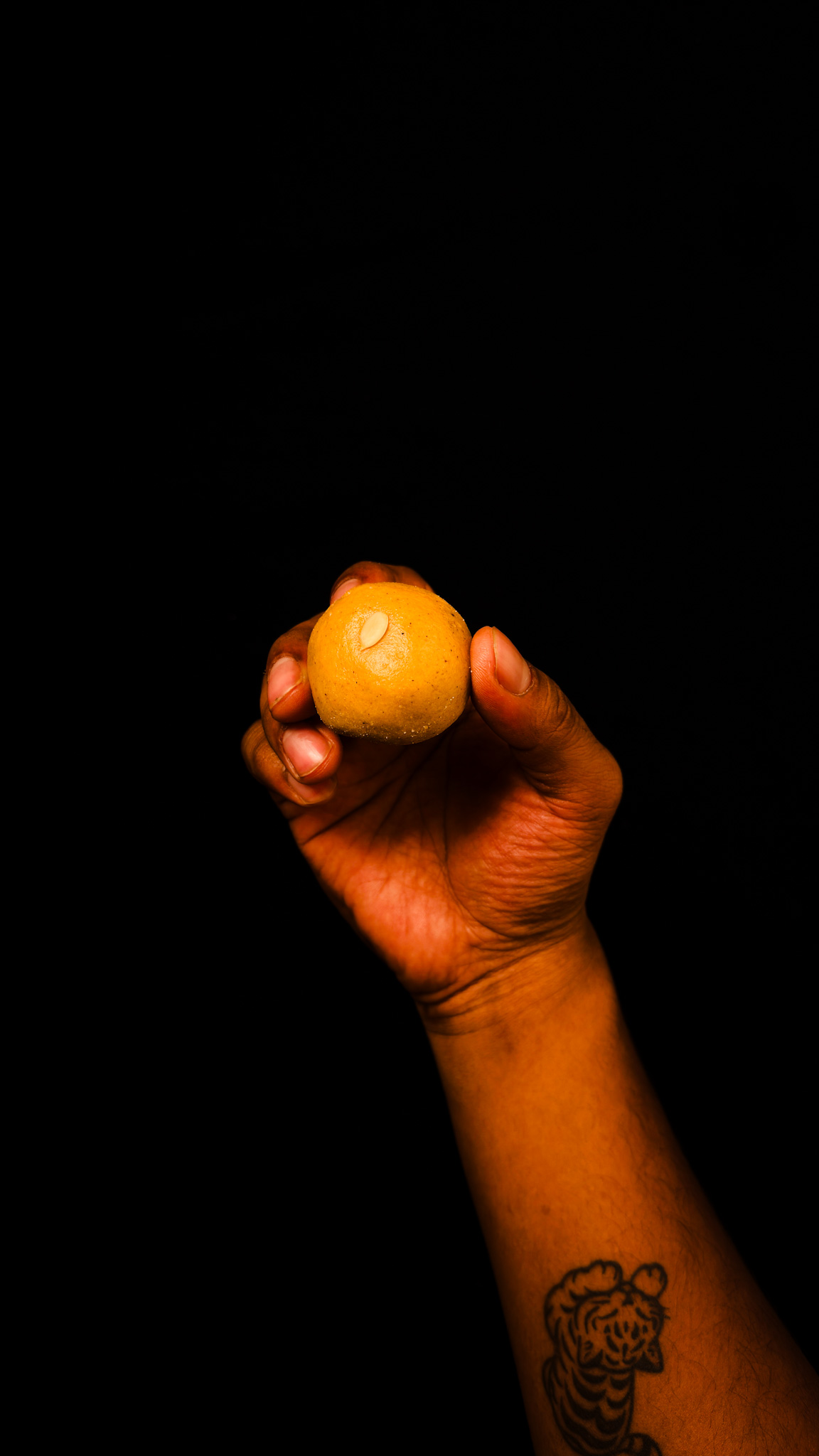
Danedar Style with Homemade Bura Sugar
This besan ladoo recipe produces the traditional Indian sweet in its danedar (grainy) form, made with roasted chickpea flour, ghee, cardamom, and homemade bura sugar for a smooth, melt-in-the-mouth finish. Besan ladoo is one of India’s most beloved sweets, a rich, roasted ball of chickpea flour bound with ghee and sugar, and this version uses a technique favored in traditional mithai kitchens.

Ladoo made from chickpea flour, sometimes called besan laddu, sanja ladoo, or boondi’s grainy cousin, have been made across the Indian subcontinent for generations, prized for their long shelf life and their place on festival tables. Besan ladoo in particular is a staple of Diwali, weddings, and other celebrations, often prepared in large batches and stored for weeks in airtight tins.
What you will need:
| Ingredient | Quantity |
| Besan (chickpea flour) | 250g |
| Sugar (for bura) | 170g |
| Ghee | 150g |
| Muskmelon seeds | 15g |
| Cardamom powder | 6.1g |

Equipments:
- Digital Scale
- Heavy-bottomed kadai or saucepan (for the sugar syrup)
- Heavy-bottomed kadai or wok (for roasting the besan)
- Candy or instant-read thermometer (optional but helpful)
- Wooden spatula or spurtle
- Wide, flat dish or tray (for cooling the granulated mixture)
- Fine sieve (for sifting the besan)
- Small bowl of water (for sprinkling)
- Airtight storage container
General Details:
Prep Time: 15 minutes
Cook Time: 45 minutes
Total Time: 1 hour 30 minutes (includes cooling time)
Yield: About 20 ladoo (30g each, 600g total)
Difficulty: Intermediate
Cuisine: Indian
Category: Mithai, Dessert
Storage: Store in an airtight container at cool room temperature for up to 2 weeks, or refrigerate for up to 1 month. Freezes well for up to 3 months; thaw at room temperature before serving.
Instructions:
Make the Bura Sugar
- Combine the sugar with water (36% of the total sugar) in a heavy-bottomed pan over medium heat.
- Stir until the sugar fully dissolves, then stop stirring and let the syrup boil undisturbed.
- Cook until the syrup reaches thread (ek-tar) stage, about 110-112°C (230-234°F), where a drop pulled between two fingers forms a single thin thread.
- Stir continuously as the syrup turns cloudy and then crystallizes into a dry, powdery white mass, about 8-10 minutes.
- Remove from heat and stir in 1 teaspoon (about 5g) of the ghee.
- Transfer to a plate, break up any lumps with the back of a spoon, and set aside to cool completely; this is your bura.

Roast the Besan
- Sift the besan to remove lumps.
- Melt the remaining ghee (about 147g) in a heavy-bottomed kadai over medium heat.
- Add the besan and stir to form a loose, grainy paste with no dry pockets.
- Reduce heat to medium-low and roast, stirring constantly, for 18-20 minutes.
- Watch for the besan to visibly release ghee at the edges of the pan and the color to deepen to a warm golden-tan; this is the ‘leaving the ghee’ cue and the main sign of doneness.
- Continue roasting until the raw, chalky smell fades and a toasted, nutty aroma develops.

Granulate the Mixture
- Remove the pan from heat as soon as the besan leaves the ghee.
- Working quickly, sprinkle 2-3 tablespoons (30-45mL) water over the hot mixture in small increments, stirring briskly after each addition.
- Stop as soon as the mixture clumps into small, sand-like granules rather than a smooth paste; do not overwork it.
- Spread the granulated mixture in a wide dish or tray.
- Let it cool until warm to the touch, a temperature you can comfortably hold in your palm, about 30-40 minutes; do not let it cool all the way to room temperature.

Assemble and Shape
- Once the besan mixture is warm (not hot), add the cardamom powder and muskmelon seeds and mix to distribute evenly.
- Add the cooled bura sugar and mix gently by hand, breaking up any clumps, until fully combined.
- If substituting store-bought powdered sugar, add it only once the mixture is closer to room temperature to prevent the sugar from melting into the ghee.
- Take about 30g of the mixture in your palm and press firmly, rotating between both palms, to form a compact, round ladoo.
- Repeat with the remaining mixture, briefly rewarming it over very low heat if it becomes too stiff to bind.
- Set the shaped ladoo on a parchment-lined tray and let them firm up at room temperature for 20-30 minutes before storing.

More Variations
- Nutty besan ladoo – Fold in 30-40g of finely chopped roasted cashews or almonds along with the muskmelon seeds for added crunch.
- Saffron-rose besan ladoo – Infuse the melting ghee with a pinch of saffron and stir a few drops of rose water into the cooled mixture for a fragrant, festive twist.
- Whole wheat besan ladoo – Replace 20-25% of the besan with roasted whole wheat flour (atta) for a nuttier, more rustic flavor.
Serving Suggestions
- Serve at room temperature on a plate lined with banana leaf or edible silver foil (chandi ka warq) for festive occasions.
- Pair with a cup of masala chai or filter coffee for an afternoon treat.
- Offer as part of a Diwali or festival mithai platter alongside kaju katli or motichoor ladoo.
- Pack in decorative boxes lined with parchment for gifting during festivals or celebrations.
Applied Techniques
- Thread (ek-tar) stage – A classic confectionery test where syrup stretched between two fingers forms a single continuous thread, used to judge when the sugar syrup is ready to crystallize.
Nutrition Profile / 100g
| Nutrient | Amount |
| Calories | 521 kcal |
| Total Fat | 29.4 g |
| Saturated Fat | 16.2 g |
| Carbohydrates | 54.3 g |
| Sugars | 33.4 g |
| Protein | 10.3 g |
| Fiber | 5.0 g |
| Sodium | 29 mg |
Note: Calculated per 100g of the finished ladoo, based on the full recipe formula (600g total yield) using standard nutrient values for besan, sugar, ghee, muskmelon seeds, and cardamom. The water used for the sugar syrup is assumed to evaporate during crystallization and is not counted toward final yield.
Approximate values based on recipe formula. Actual nutrition may vary.
Tips for Best Results:
Sift the bura sugar to remove lumps and ensure even, consistent roasting.
- Use a heavy-bottomed kadai for roasting; thin pans create hot spots and burn the besan unevenly.
- Drop the heat to medium-low as soon as the besan starts to color; it can go from golden to burnt within moments.
- The ‘leaving the ghee’ cue, a visible sheen of ghee pooling at the edges of the besan, is a more reliable doneness marker than color alone.
- Sprinkle the granulation water in small increments and stir immediately after each one; adding it all at once turns the mixture into a paste instead of granules.
- Making bura (crystallized sugar) rather than using regular granulated sugar gives the ladoo a smoother, less gritty finish; it is worth the extra step.
- Test readiness for shaping by pressing a small amount between your palms; if it holds together without cracking, it is ready.
- Store bura sugar in an airtight container if not using it immediately, since it absorbs moisture from the air quickly.

Troubleshooting Guide:
| Issue | Possible Cause | Fix |
| Ladoo mixture will not bind | Mixture cooled too much before shaping, or the besan-to-ghee ratio was off | Gently rewarm over very low heat, stirring, then reshape while warm. |
| Ladoo tastes raw or chalky | Besan was under-roasted | Roast longer over medium-low heat until besan visibly releases ghee and smells nutty, not raw. |
| Besan is burnt or has dark specks | Heat too high or an uneven pan | Use a heavy-bottomed pan and keep heat at medium-low, stirring constantly in the final 5 minutes. |
| Sugar syrup will not crystallize | Syrup did not reach thread stage before cooling, or was not stirred enough after adding ghee | Return to low heat and continue stirring; if far below thread stage, recook the syrup to the correct temperature. |
| Bura sugar sets into a hard block instead of powder | Stirring stopped too early or the syrup was cooked past thread stage | Break up the block with a spoon, or pulse briefly in a blender before using. |
| Mixture feels greasy or oily | Too much ghee relative to besan, or ghee added too quickly during roasting | Spoon off a little excess ghee before adding the sugar. |
| Granules did not form; mixture is a smooth paste | Water added all at once, or the mixture was too hot or too cold when sprinkled | Work off direct heat but while still warm, add water a teaspoon at a time, stirring briskly between additions. |
| Sugar melts into the mixture instead of staying granular | Sugar added while the mixture was still too hot | Cool the besan-ghee mixture to a hand-warm, not hot, temperature before folding in the sugar. |
You Might Also Like
- Traditional Kacha Gola Recipe (Raw Cottage Cheese Balls)
- Rosogolla – popular Indian dessert
- Kalakand, a classic Indian sweet
Snapshot Recipe
Bura Sugar
| Have a heavy-bottomed pan ready | ||||
| Sugar | dissolve & boil to thread stage 110-112°C | stir & crystallize 8-10 min | cool & break up lumps | |
| Water | ||||
| Ghee | off heat, stir in | |||
Besan Ladoo Mixture
| Sift besan before use | ||||||
| Keep water on hand for sprinkling | ||||||
| Ghee | melt | add & roast 18-20 min | off heat, sprinkle & granulate | cool to warm 30-40 min | fold in | shape into ladoo |
| Besan | ||||||
| Water, for sprinkling | ||||||
| Bura sugar | ||||||
| Muskmelon seeds | ||||||
| Cardamom powder | ||||||
This recipe is well suited for festival mithai platters, gifting boxes, or a jar of ladoo to keep on hand with chai. Making bura (crystallized sugar) separately, then granulating the roasted besan, takes a little more effort than a shortcut version made with powdered sugar, but it produces a noticeably better texture and is worth it for special occasions.
Don’t forget to share your results and tag @bake.hows on instagram
