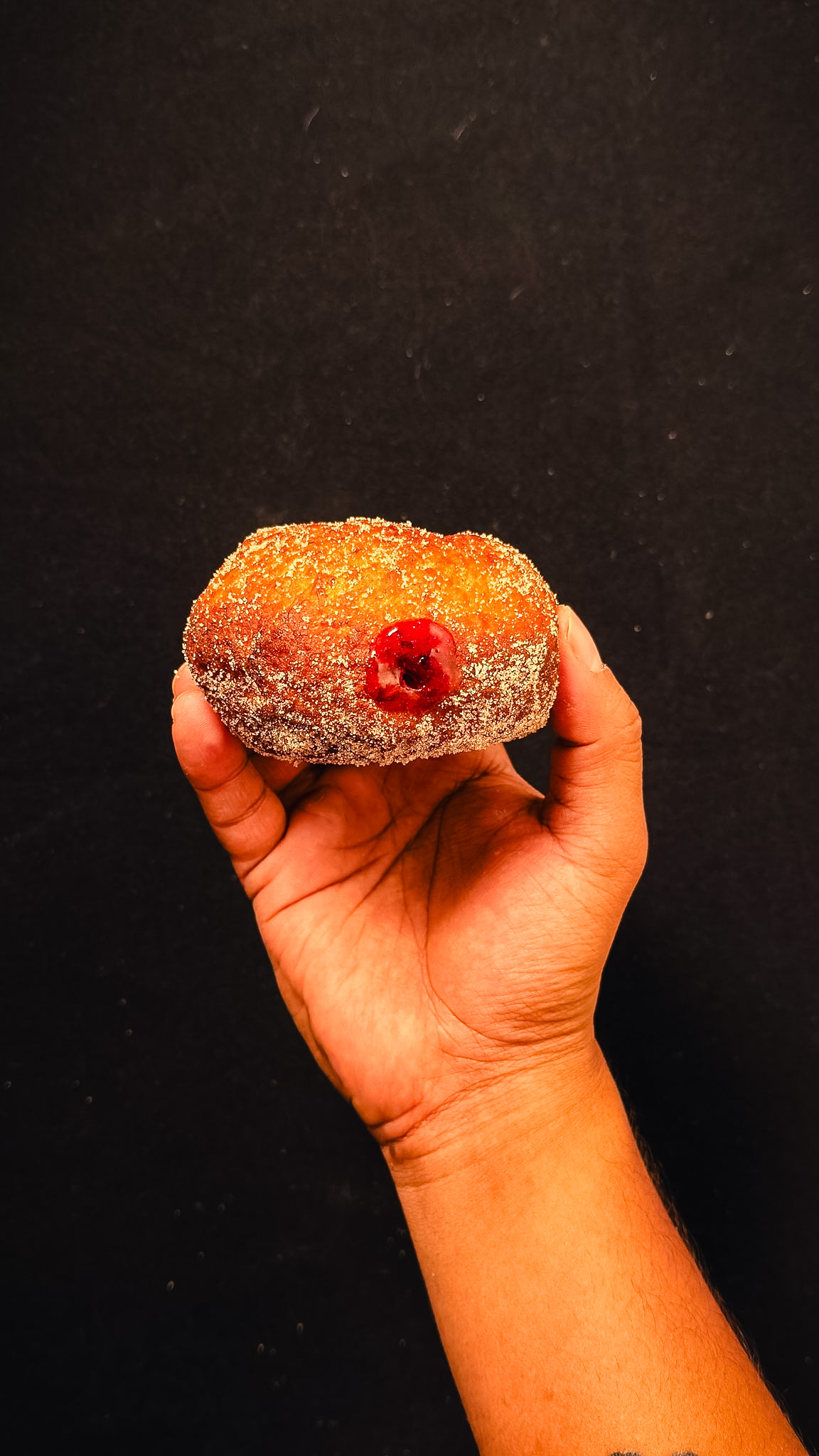
Blueberry Jam-Filled German Doughnuts
This Berliner doughnut recipe gives you the real thing, a classic German jam-filled doughnut made from an enriched yeasted dough, deep-fried until golden with a characteristic white equatorial ring, filled with blueberry jam, and rolled in warm cinnamon sugar. The Berliner (known as Berliner Pfannkuchen in Germany and Krapfen in Bavaria) belongs to the same enriched dough family as the French beignet and Austrian Faschingskrapfen — soft, pillowy, and buttery, with a tight crumb that holds the filling without collapsing.

Historically associated with carnival season and New Year’s in Germany, the Berliner today appears year-round at bakeries and street stalls across Central Europe. The hallmark white ring around the equator is your visual quality benchmark, it forms when the above-oil-line portion of dough continues expanding after the submerged half has already set. This version uses blueberry jam for a deep berry note and finishes with cinnamon sugar for warmth and spice, a pairing that works better than plain powdered sugar with fruit fillings.
What you will need:
Dough
| Ingredient | Quantity |
|---|---|
| All-Purpose Flour | 300g |
| Sugar | 30g |
| Salt | 3.6g |
| Instant Yeast | 6g |
| Vanilla Extract | 6g (6mL) |
| Egg | 58.8g (~1 large egg + 1 yolk) |
| Whole Milk (warm) | 168g (168mL) |
| Unsalted Butter (softened) | 30g |
Coating and Filling
| Ingredient | Quantity |
|---|---|
| Blueberry Jam | 200g |
| Caster Sugar | 100g |
| Ground Cinnamon | 5g |
Frying
| Ingredient | Quantity |
|---|---|
| Neutral Oil (sunflower or canola) | 1 litre |

Equipments:
- Digital Scale
- Stand mixer with dough hook attachment
- Instant-read thermometer (for oil temperature, essential)
- Deep heavy-bottomed pot or Dutch oven (minimum 4-litre capacity)
- Piping bag with Bismarck/filling nozzle
- Bench scraper
- Baking tray lined with parchment
- Wire rack over tray (for draining)
- Spider skimmer or slotted spoon
General Details:
Prep Time: 30 minutes
Cook Time: 20 minutes (frying)
Total Time: 3 hours 30 minutes (including proofing)
Yield: 8 Berliners
Difficulty: Intermediate
Cuisine: German
Category: Pastry
Storage: Best consumed the day of frying. Store at room temperature loosely covered for up to 1 day. Do not refrigerate — cold stales enriched dough rapidly. Not suitable for freezing once filled.
Instructions:
Mix the Dough
- Combine flour, sugar, salt, and instant yeast in the stand mixer bowl, keep salt and yeast on opposite sides.
- Add vanilla, egg, and warm milk, then mix on low with the dough hook until a shaggy mass forms, about 2 minutes.
- Increase to medium and knead for 5 minutes until the dough begins to smooth.
- Add softened butter in 3–4 additions on medium-low, waiting for each piece to incorporate before adding the next.
- Increase to medium-high and knead 4–5 minutes until the dough is smooth, elastic, and pulls cleanly from the bowl.
- Perform the windowpane test, the dough should stretch to a translucent membrane without tearing.


Bulk Fermentation
- Round the dough into a ball and place in a lightly oiled bowl, seam-side down.
- Cover tightly with plastic wrap and proof at room temperature (24–26°C) for 60–75 minutes until doubled.
- Gently degas by folding once, then turn out onto an unfloured surface.

Shape and Final Proof
- Scale the dough into 8 equal pieces (~75g each).
- Pre-shape each piece into a rough ball, cover, and bench-rest for 10 minutes.
- Final-shape by pulling surface taut underneath and pinching the seam firmly, a tight surface prevents blowouts during frying.
- Place on a parchment-lined tray, seam-side down, spaced 5cm apart.
- Cover loosely with a clean towel or oiled plastic wrap.
- Proof 45–60 minutes until visibly puffed and slow-rebounding when poked.
- Do not over-proof, over-proofed Berliners will spread in the oil and produce a dense crumb.

Fry
- Heat oil in a deep pot to 170–175°C, use a thermometer; this temperature range is non-negotiable.
- Lower 2–3 Berliners into the oil using their parchment squares to avoid deflating the dough.
- Fry 2–3 minutes on the first side until deep golden-brown, then flip with a spider skimmer.
- Fry the second side for 2 minutes, the white equatorial ring should be visible.
- Drain on a wire rack and allow oil to return to temperature before each batch.
- Cool 10 minutes before filling.
Coat and Fill
- Mix caster sugar and cinnamon in a shallow bowl.
- Roll each filled Berliner in cinnamon sugar while still warm — the residual heat helps coating adhere.
- Load blueberry jam into a piping bag fitted with a Bismarck/filling nozzle.
- Insert nozzle into the white ring at the side of each Berliner and pipe 20–25g of jam until gentle resistance is felt.

Try these!
- Classic Rosehip Jam (Traditional) : Swap blueberry jam for rosehip (Hagebutte) jam, the traditional German filling. Coat in powdered sugar instead of cinnamon sugar for an authentic Berliner Pfannkuchen.
- Custard-Filled (Vanillecreme) : Fill with a stiff crème pâtissière flavoured with vanilla bean paste. Coat in vanilla sugar or dust with powdered sugar. A popular variation in Austrian bakeries.
- Nutella & Hazelnut Praline : Fill with warmed Nutella or homemade hazelnut praline cream. Roll in praline powder mixed with caster sugar for added crunch.
- Lemon Curd with Poppy Seed Sugar : Fill with thick lemon curd and coat in a mixture of fine sugar and toasted ground poppy seeds — a classic Central European flavour pairing.
- Vegan Berliner : Replace egg with aquafaba (58g), milk with oat milk, and butter with refined coconut oil. Texture will be slightly less tender but structurally sound; extend proof times by 15–20 minutes.

Serving Suggestions
- Serve within 2 hours of frying for the best contrast between the crisp cinnamon sugar crust and pillowy crumb.
- Pair with a strong black filter coffee or flat white, the bitterness cuts through the sweetness of jam and sugar.
- For a brunch spread, arrange on a wooden board dusted with extra cinnamon sugar alongside a ramekin of blueberry jam.
- Serve with a scoop of crème fraîche for a plated dessert version, the tang tempers the richness of the enriched dough.
- Day-old Berliners are excellent sliced and pan-fried in butter, served with vanilla ice cream and a warm blueberry compote.
- Crumble misshapen or over-proofed pieces into coarse breadcrumbs, toast in butter, and use as a crunchy parfait topping.
Applied Techniques
- Windowpane Test : Stretching a small piece of dough to translucency confirms sufficient gluten development before bulk fermentation begins
- Final Proof (Poke Test) : The slow spring-back test confirms the yeast has adequately gassed the dough for optimal fryer spring
- Deep-Frying Thermometry : Maintaining 170–175°C ensures simultaneous Maillard browning at the surface and complete starch gelatinisation and egg protein coagulation in the interior
- Bismarck Filling : Injecting jam through the equatorial ring preserves the exterior crust and distributes filling evenly through the crumb
Nutrition Profile / 100g
Approximate values based on recipe formula. Includes estimated oil absorption (~12% of dough weight for deep-fried enriched dough) and blueberry jam filling distributed across 8 pieces. Actual nutrition may vary.
| Nutrient | Amount |
|---|---|
| Calories | 342 kcal |
| Total Fat | 12.4g |
| Saturated Fat | 3.8g |
| Carbohydrates | 51.6g |
| Sugars | 18.2g |
| Protein | 6.1g |
| Fiber | 1.4g |
| Sodium | 198mg |
Note: These values are approximate and can vary based on the specific brands and types of ingredients used, as well as portion sizes.

Tips for Best Results:
Milk temperature: Use milk at 35–38°C (body-warm) to support fermentation without killing yeast activity.
- Oil temperature is everything: Below 165°C, the dough absorbs excess oil and turns greasy; above 180°C, the exterior sets too fast while the centre remains raw. Maintain 170–175°C throughout.
- Parchment transfer method: Place proofed Berliners on individual squares of parchment so you can lower them into the oil without touching the dough.
- Chill the jam: Refrigerate blueberry jam to 10–15°C before piping — cold jam is firmer and far less likely to leak back out of the insertion point.
- Coat at the right moment: Roll in cinnamon sugar 5 minutes off the fryer — too hot and the sugar dissolves into surface oil; too cold and it won’t stick.
Troubleshooting Guide:
| Issue | Possible Cause | Fix |
|---|---|---|
| No white ring after frying | Oil too hot, or dough under-proofed — exterior sets before centre expands | Lower oil to 170–175°C; ensure buns pass the poke test before frying |
| Greasy, oily exterior | Oil temperature too low (below 165°C) — dough absorbs oil before crust sets | Preheat oil fully before adding dough; use a thermometer, not visual cues |
| Dense, doughy interior | Under-proofed, or oil too hot — outside browned before inside cooked | Proof until visibly puffed and slow-rebounding; maintain 170–175°C |
| Jam leaking out after filling | Jam too warm and runny, or over-filled | Chill jam to 10–15°C before piping; fill only until gentle resistance is felt |
| Dough too sticky to shape | Under-developed gluten, or butter added too early | Ensure windowpane passes before adding butter; chill dough 15 minutes if too soft |
| Flat, spreading buns during final proof | Over-proofed, or shaping seam not tight enough | Use poke test not clock alone; shape with firm surface tension |
| Cinnamon sugar not adhering | Berliners too cool when coated — oil residue has set on surface | Coat within 5 minutes of removing from fryer while still warm to the touch |
| Uneven browning (pale patch on one side) | Buns not flipped at correct time, or oil not deep enough | Flip when first side is deep golden; oil depth should be at least 6–7cm |

You Might Also Like
Don’t forget to share your results and tag @bake.hows on instagram
